- Published
- Victor Gaier
- 5 min Read
Low-Voltage Cabling Installation: A Complete Guide for Businesses
Summarize With:
In This Article
Modern businesses depend on reliable connections to support communication, networking, and security equipment. Low-voltage cabling installation provides the infrastructure needed to connect these systems across a commercial property. The process involves assessing building requirements, selecting suitable cables, planning routes, installing and organizing connections, and testing the completed setup.
Proper planning helps businesses create an organized cabling infrastructure that supports current operations and allows for future changes.
What is Low-Voltage Cabling and What Is It Used For?
Low-voltage cabling refers to cables designed to carry data, communication signals, or control signals for different electronic systems. Unlike standard electrical power wiring, these cables support applications that do not primarily distribute power to conventional electrical equipment.
In commercial buildings, low-voltage cabling can support computer networks, telephone systems, CCTV cameras, access control equipment, video intercoms, and other connected devices.
The cable type depends on the system being connected and its installation requirements. Choosing suitable cables and installing them correctly helps establish reliable connections between equipment and supports the overall performance of the infrastructure.
Which Business Systems Use Low-Voltage Cabling?
Commercial low-voltage cabling supports several systems that businesses use for daily operations, communication, and property security.
Common applications include:
- Data and networking: Network cables connect computers, routers, switches, and other network equipment to support business data communication.
- Telephone systems: Cabling supports communication connections between telephone equipment and relevant infrastructure.
- Security cameras: Compatible cabling connects CCTV cameras with recording equipment or network infrastructure.
- Access control systems: Connections support communication between compatible access control devices and their associated equipment.
- Video intercom systems: Cabling connects entry-point equipment with indoor communication stations.
- Other connected systems: Certain building communication and control applications also require dedicated low-voltage connections.
The exact cabling requirements vary by application. A building assessment helps determine which systems need connections and what infrastructure is required.
What Should Businesses Consider Before Low-Voltage Cabling Installation?
Planning is an important part of low-voltage wiring installation. Before work begins, businesses should evaluate the property and identify the connections required for their operations.
Consider these factors:
- Building layout: Review floors, rooms, equipment areas, and possible cable routes.
- Connection requirements: Identify the number and locations of network connections and connected devices.
- Cable selection: Choose cable types according to the intended application and equipment requirements.
- Existing infrastructure: Review available conduits, pathways, wiring, and equipment locations.
- Future expansion: Consider whether additional connections or equipment may be needed as the business grows.
- Installation conditions: Account for environmental conditions, cable protection, and appropriate separation from electrical wiring where required.
A clear plan helps reduce installation complications, disorganized wiring, and unnecessary changes after the work is completed.
How is Low-Voltage Cabling Installed in a Commercial Building?
Low-voltage cabling installation generally follows a series of steps. Each stage helps ensure that the infrastructure is suitable for the building and the systems it needs to support.
1. Assess the Building and Cabling Requirements
The process begins with an assessment of the property. Installers review the floor plan, equipment locations, connected systems, and number of required connections.
This helps identify where cables need to run and which areas require network or other low-voltage connections. Existing infrastructure is also considered to determine whether it can support the planned installation.
2. Select Suitable Cables and Materials
The next step is choosing cables and installation materials according to the intended application. Different systems may require different cable types, connectors, and supporting components.
For example, data networking, telephone connections, and security equipment may have different cabling requirements. Selection should account for equipment compatibility, the installation environment, and the design specifications.
Using appropriate materials helps create connections that meet the needs of the systems being installed.
3. Plan Cable Routes and Prepare Pathways
Before cables are installed, suitable routes are identified throughout the building. Installers consider the distance between equipment locations, available pathways, access points, and building structure.
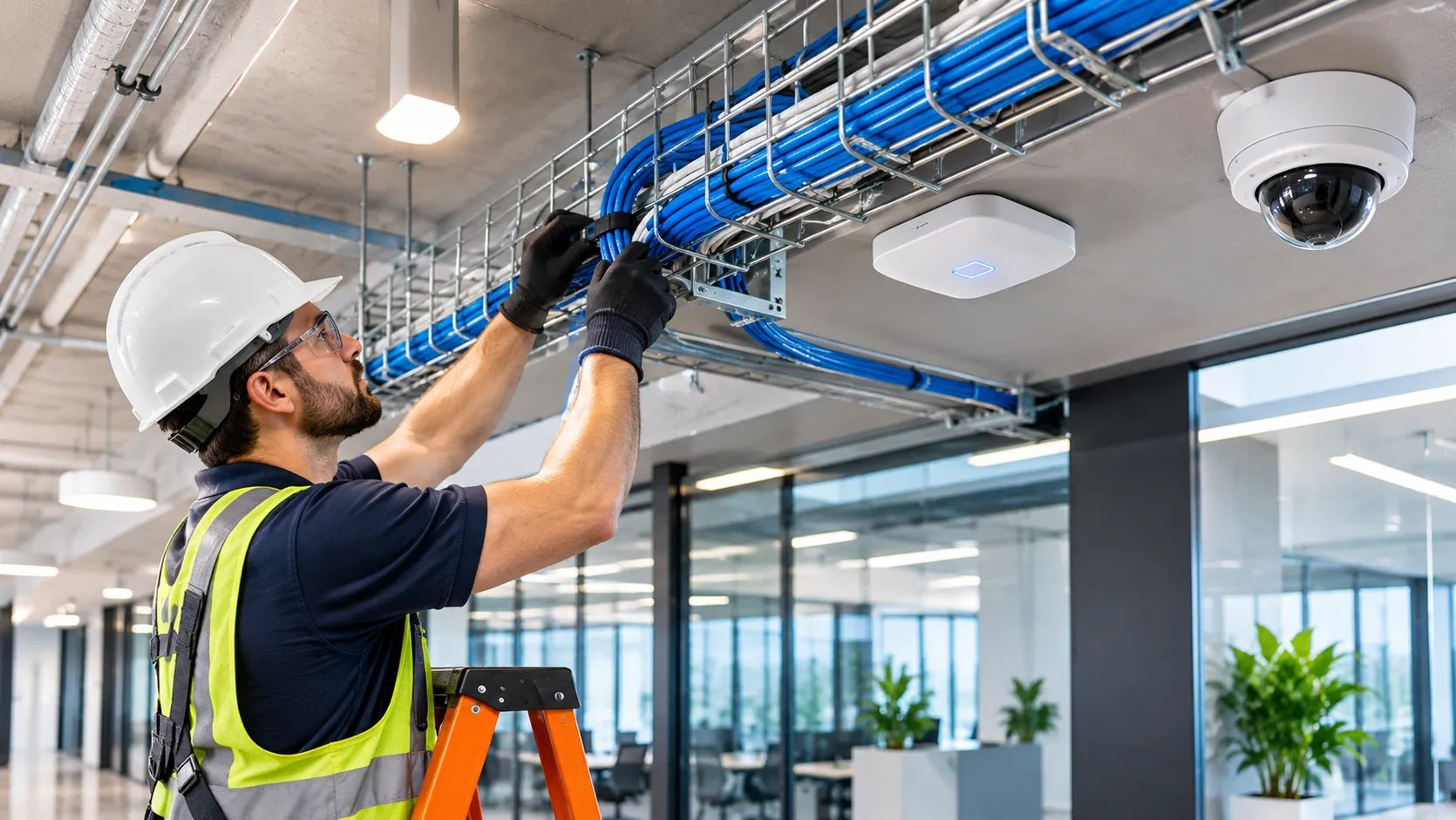
Where required, conduits, cable trays, and other pathways are prepared to support cable routing and protection. Planning routes in advance also helps keep cables organized and accessible for future maintenance.
4. Install and Organize the Cables
Once pathways are ready, cables are routed through the planned locations and connected to the required equipment points. Installers should follow the system design and appropriate handling practices to avoid damaging cables during installation.
Cable organization and labeling are also important at this stage. Identifying individual cables and their connection points makes the infrastructure easier to understand and manage.
5. Terminate and Test Connections
After cable routing, the cables are terminated at the required connection points using suitable connectors and termination methods.
Testing is then performed according to the cable type and intended application. This helps identify issues such as incorrect connections, termination faults, or damaged cables before the infrastructure is handed over.
Why is Proper Cable Organization and Labeling Important?
Cable organization helps businesses maintain a clear and manageable cabling infrastructure. When multiple systems share equipment areas or pathways, unidentified cables can make troubleshooting and future changes more difficult.
Proper labeling helps technicians identify individual connections without tracing every cable manually. Organized routing also makes equipment areas easier to inspect and maintain.
For businesses planning future expansions, clear cable identification can simplify the addition of new connections and reduce confusion during maintenance. Cable management should therefore be considered an essential part of commercial network cabling installation, not just a finishing task.
How Do You Test Low-Voltage Cabling After Installation?
Testing helps verify that installed cables and connections are suitable for their intended applications. The testing method depends on the cable type and the system it supports.
Post-installation checks may include:
- Checking cable continuity and termination.
- Identifying wiring faults or damaged connections.
- Verifying connections using appropriate testing equipment.
- Confirming cable labels and connection documentation.
- Addressing identified issues before handover.
Testing provides an opportunity to correct installation problems before connected systems are placed into regular operation.
How Can Businesses Maintain Their Low-Voltage Cabling Infrastructure?
Regular inspection helps businesses keep their cabling infrastructure organized and in suitable condition. Accessible cables and connections should be checked for visible damage, loose connections, and other issues.
Businesses should also maintain updated cable labels and documentation. After renovations, equipment changes, or additional installations, the cabling layout should be reviewed and records updated where necessary.
Any identified faults should be assessed and corrected by appropriately qualified professionals. Good maintenance practices make future troubleshooting and system modifications easier.
Why Choose Cisco Fire Systems for Low-Voltage Cabling Installation?
Cisco Fire Systems provides low-voltage cabling and network cabling installation services for commercial and residential properties. A suitable installation begins with understanding the building layout, existing infrastructure, equipment locations, and the connections required for business operations.
Planning these requirements helps establish organized cable routes and suitable connections for the systems being supported. Cisco Fire Systems can discuss a property’s cabling requirements and help determine the appropriate next steps, including arranging a site survey.
As a family-owned company established in 1982, Cisco Fire Systems has a long-standing presence in the fire and security industry. Businesses planning a cabling project can contact the company to discuss their installation needs.
Conclusion
Low-voltage cabling installation is an important part of commercial building infrastructure. Proper planning, suitable cable selection, organized routing, correct termination, and testing help businesses establish connections for networking, communication, and compatible security systems. Regular maintenance and updated documentation also support future troubleshooting and expansion.
Cisco Fire Systems provides low-voltage cabling and networking installation services to help businesses address their infrastructure requirements. Contact Cisco Fire Systems to discuss your property and arrange a site survey.
Frequently Asked Questions
What is low-voltage cabling used for in commercial buildings?
Low-voltage cabling supports systems such as computer networks, telephone connections, CCTV cameras, access control equipment, and video intercoms. The required cable depends on the application.
How long does low-voltage cabling installation take?
Installation time depends on building size, cable routes, the number of connections, existing infrastructure, and project complexity. A site assessment helps establish the installation scope.
Can low-voltage cabling be installed in an existing building?
Yes. Existing commercial buildings can be assessed for suitable cable routes and installation options. Available pathways, building structure, and existing infrastructure influence the approach.
Does low-voltage cabling need to be tested after installation?
Yes. Testing helps identify connection faults, termination issues, and damaged cables. The appropriate testing method depends on the cable type and its intended application.
About the author

Victor Gaier
Victor Gaier is an Electrical Engineer with 40+ years of experience specializing in fire alarm systems, CCTV, access control, intrusion alarms, and commercial security solutions across Nassau County and Long Island.
Share this article
Related Blogs
Explore more expert insights, tips, and updates on fire protection and security solutions.



Need Assistance? Get Your Free Site Survey
Protect your home or business with reliable fire protection and security solutions from Cisco Fire Systems. Tell us about your property and security needs, and our team will recommend the right solution for you.